The Tool That Turned on You
Your calendar was supposed to help. It was supposed to give you a clear picture of your day, keep you on time, and prevent the chaos of forgotten commitments. And at first, it probably did.
But somewhere along the way, the relationship shifted. Instead of you using the calendar, the calendar started using you. Instead of creating clarity, it started creating pressure. Every empty slot felt like wasted potential. Every packed day felt like a march toward exhaustion. The tool that was supposed to reduce stress became a generator of it.
This is not a you problem. It is a design problem. Most calendar apps are built to show you time as a finite, partitioned resource — and when you see your life laid out in thirty-minute blocks, it is hard not to feel like every block needs to be filled, optimized, and accounted for.
Here are five signs your calendar has crossed the line from helpful to harmful — and what to do about each one.
Sign 1: You Feel Anxious Looking at Your Week
A calendar should feel like a map — something that gives you orientation and helps you navigate. If looking at your weekly view feels more like looking at a wall of obligations, something has gone wrong.
This happens when calendars become repositories for everything — meetings, reminders, tasks, aspirations, habits, recurring obligations. The visual weight of a full calendar creates a psychological weight. Your brain scans all those blocks and interprets them as demands, even if half of them are optional or routine.
What to do: Separate what is fixed from what is flexible. A meeting at 2 PM is fixed. “Work on the report” is flexible. Fixed events belong on a calendar. Flexible tasks belong somewhere else — a simple list, a planning app, your head. When your calendar shows only the immovable commitments, the white space returns, and with it, your breathing room.
This is the same principle backed up choosing between digital and paper planners — it is not about the format, it is about what each tool is asked to hold.
Sign 2: You Schedule Things You Used to Just Do
There was a time when you ate lunch without putting it on a calendar. When you went for a walk because you felt like it, not because “Walk” was blocked from 12:30 to 1:00. When you called a friend spontaneously, not during a scheduled “Social Time” block.
When basic human activities start appearing as calendar events, your calendar has expanded beyond its useful boundary. Time blocking has value for deep work and complex coordination. But blocking “Read for 30 minutes” or “Relax” is a sign that you have lost trust in your own ability to use unstructured time well.
What to do: Remove anything from your calendar that you would do naturally without a prompt. Keep the things that have a specific time and would be missed without a reminder. Let the rest happen organically. If you find that you never relax or read without scheduling it, the problem is not your calendar — it is your relationship with rest, and that is a separate conversation worth having.
Sign 3: An Empty Day Feels Wrong
If you look at a day with nothing on it and feel a twinge of guilt — like you should be doing more, like you are wasting the day — your calendar has rewired your relationship with time.
Empty days are not failures. They are the natural state of a healthy life. Most of your best memories — the long conversation that went nowhere, the afternoon spent wandering, the spontaneous decision to drive somewhere new — happened in unstructured time. Your calendar cannot produce those moments. It can only prevent them.
What to do: Protect empty time the way you protect scheduled time. Some people literally block “Nothing” on their calendars to prevent other things from filling the space. That is a clever workaround, but the deeper fix is recognizing that unscheduled time is not unproductive time. It is the space where creativity, recovery, and genuine living happen.

Sign 4: You Cannot Be Spontaneous
Someone asks if you want to grab coffee. Your first instinct is to check your calendar. Not because you think you have something — but because you have been trained to verify before committing to anything.
When your calendar becomes the authority on whether you can do something, you have surrendered a fundamental human capability: the ability to make decisions in the moment based on how you feel, what you want, and who is in front of you.
Spontaneity requires slack. It requires gaps in the schedule that are not earmarked for anything. If every hour has a purpose, no hour is available for the unplanned moments that often turn out to be the best parts of your week.
What to do: Leave at least one significant block of unscheduled time each day. Not for a specific task — for whatever comes up. For the coffee invitation, the unexpected conversation, the sudden burst of energy to work on something you care about. If you are managing a busy schedule, this buffer is not a luxury — it is how you stay sane inside the busyness.
Sign 5: Your Reminders Create More Stress Than They Prevent
The original purpose of a reminder is simple: make sure you do not forget something. But modern calendar apps have turned reminders into a barrage. Fifteen minutes before every event. Ten minutes before. Five minutes. A notification badge that lingers until you dismiss it.
If you are getting twelve notifications a day from your calendar, and each one produces a micro-spike of “I need to do something,” your reminders are not helping. They are training your nervous system to associate your phone with obligation.
What to do: Turn off most reminders. Keep them for the things that genuinely require advance notice — a meeting you need to prepare for, a departure you cannot miss. Remove them for routine events you will attend regardless. Your calendar should inform you at the right moment, not nag you continuously. The difference between reminders that work and reminders that do not often comes down to timing and context — a single well-placed nudge beats ten automated pings.
The Calendar Should Serve You
All five signs point to the same underlying issue: the calendar has become the master instead of the servant. It dictates when you eat, when you rest, when you are allowed to say yes to something unexpected. It fills your visual field with obligations and your mental field with pressure.
A healthy relationship with your calendar looks like this:
- You glance at it in the morning and feel oriented, not overwhelmed
- It holds fixed commitments and nothing else
- Unscheduled time is normal and welcome
- Reminders arrive when genuinely needed, not reflexively
- You can say yes to something without checking an app first
Getting there might mean deleting half your calendar events. It might mean turning off notifications. It might mean switching to a tool that does not treat your life as a grid of thirty-minute blocks to be filled.
A Different Kind of Planner
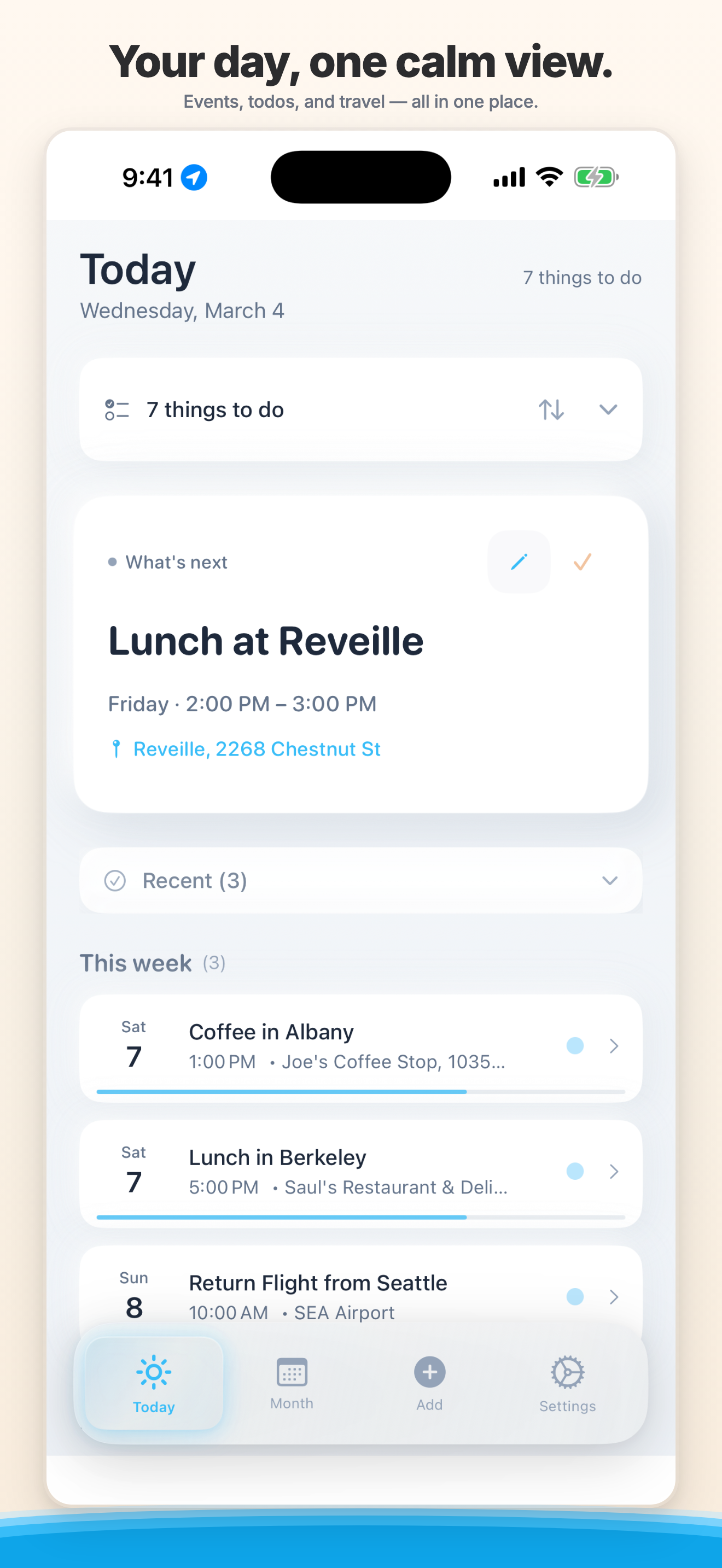
Composed is built around the idea that your planner should reduce cognitive load, not create it. There is no week view crammed with color-coded blocks. There is no notification barrage. There is no pressure to fill every slot.
Instead, there is today. What is happening, what needs preparation, when you need to leave. The app surfaces what matters and stays quiet about the rest. Smart reminders arrive based on the actual nature of the event — a graduated awareness system that gives you early signals for important things and stays silent for routine ones.
Your calendar should feel like a composed, knowledgeable assistant. Not a drill sergeant, not an anxiety machine, not a guilt trip. If your current tool makes you feel worse about your time than you did before you had it, the tool is broken — not you.